















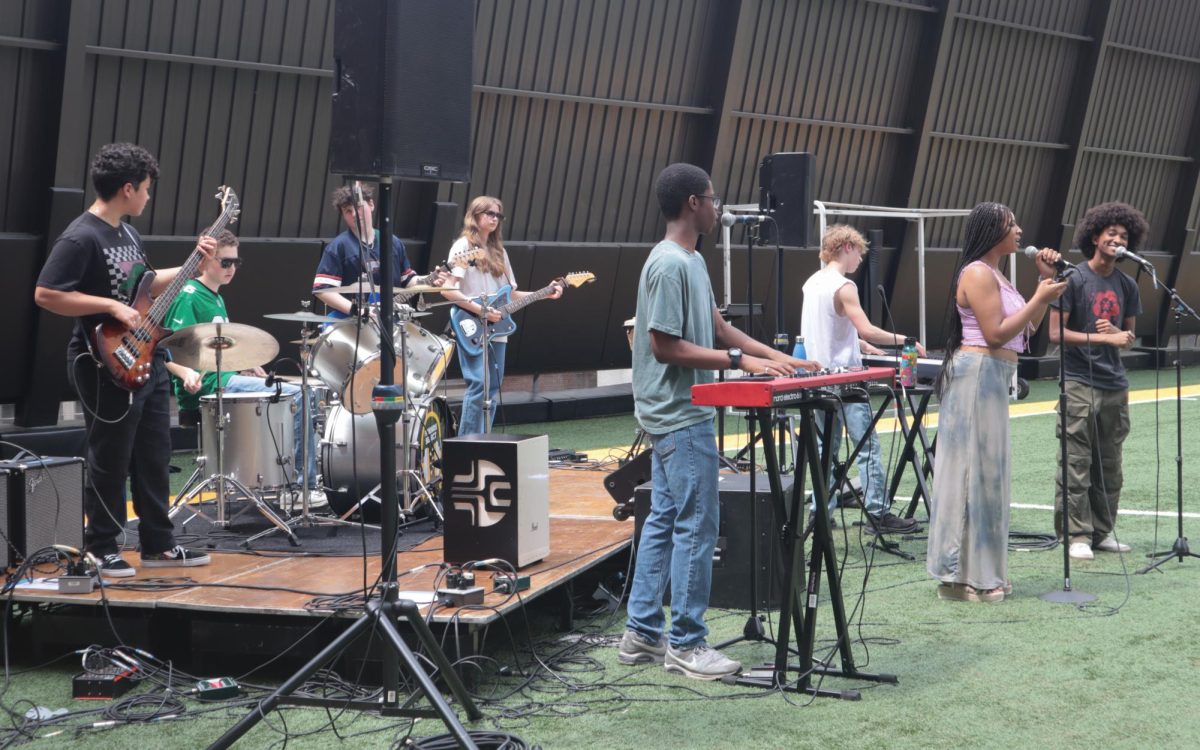




The Holiday Sing happens every year, and this year it will take place on Friday, December 19th, at 2 pm in the Race Street Meetinghouse. Families and students are welcome to join the celebration. This year, the school is committed to having the Holiday Sing be totally paperless as part of an initiative to be more environmentally sustainable. Lyrics for all the songs will be projected or shown on your phone. Songs will include Rudolph the Red-Nosed Reindeer, Dreidel Dreidel Dreidel, Jingle Bells, Feliz Navidad, Let It Snow, The Latke Song, Deck the Halls, O Kwanzaa, Mr. Grinch, Ocho Kandelikas, Silent Night, Frosty the Snowman, and The Twelve Days of Christmas, which celebrate the importance of holiday traditions.
Rudolph the Red-Nosed Reindeer- Maeve ‘27 and Ruby Doggett
“Rudolph the Red-Nosed Reindeer” is a song written by Johnny Marks and sung by Gene Autry. The song is based on the 1939 story Rudolph the Red Nosed Reindeer. The story is a story about a young reindeer who is mocked by his fellow reindeer for his red nose. Rudolph eventually becomes a hero by guiding Santa’s sleigh through thick fog with his red nose. The story was turned into a song in 1939 and released as a children’s record in September 1949 by November, it hit No.1 on the U.S charts. Rudolph The Red Nosed Reindeer continued to be one of the most popular Christmas songs.
Sources:
Dreidel Dreidel Dreidel: Elise 27’ and Emilia 27’
“Dreidel Dreidel Dreidel” is a children’s Hanukkah song written by Samuel S. Grossman and Samuel E Goldfarb in 1927. It is also known as the “Dreidel Song” or “I Have a Little Dreidel”. The melody follows a Yiddish version, with “Dreidel Dreidel Dreidel” being a direct translation of the Yiddish song. The original song’s lyrics were written by Mikhl Gelbart. Although the melody is credited to both the English and Yiddish versions’ composers, the melody is the same in both, raising the question of who actually wrote it. The song was first published in a collection by the United Synagogue of Conservative Judaism in a collection of songs titled The Songs We Sing (1950). The song is now a popular holiday song for Jewish people and has become part of Hanukkah celebrations.
Source:
Jingle Bells: Maddie Orr ‘28, Will Perkins ‘27
“Jingle Bells” was written and composed by James Pierpont in 1857, and was originally called “The One Horse Open Sleigh”. Despite being so iconic during the Christmas season, “Jingle Bells” was originally written as a Thanksgiving song. The original lyrics were also slightly different, but were changed to be more appropriate for church and family settings, originally including topics about drag racing and crashing. Now this song is about the joyous feeling of the holiday season and Christmas time. It makes people think of the light, happy feeling that resembles flying over a hill on a sleigh. “Jingle Bells” reminds people of the feeling of winter, and despite the not super happy lyrics, has a happy beat that people think of year-round.
Source:
Feliz Navidad – Layla Miller ‘28
Feliz Navidad was released in 1970 and sung by José Feliciano. Feliz Navidad is one of the most played Christmas songs and was inducted into the Grammy Hall of Fame. The song has only nineteen words, and it’s become an iconic, bilingual Christmas anthem. The chorus repeats “Feliz Navidad”, which translates to “Happy Christmas.”
Sources:
Let it Snow – Anna Masino ‘27
“Let it Snow! Let it Snow! Let it Snow!” or simply, “Let it Snow” was originally written by lyricist Sammy Cahn and composed by Jule Styne in July 1945, during a heatwave, while they wished for colder temperatures. The contents of the lyrics include spending time with a loved one, sitting by the fireplace enjoying popcorn. The song does not mention any specific holiday, but it is often associated with Christmas because of its winter imagery. It is often played on radio stations during the holiday season. The most famous version of the song is the one released by American singer Dean Martin in 1959, for his album A Winter Romance. It has since become a staple in Christmas music.
Sources:
- https://en.wikipedia.org/wiki/Let_It_Snow!_Let_It_Snow!_Let_It_Snow!
- Dean Martin – Let It Snow! Let It Snow! Let It Snow! Lyrics | Genius Lyrics
The Latke Song – Lyla Harel ’28 and Joely Kaplan ‘28
“The Latke Song” was written by Jewish-American singer and songwriter Debbie Friedman, released in 1990. The song enlightens listeners about Latkes, a food similar to a potato pancake, that are eaten by Jewish people on Hanukkah. Latkes are eaten on Hanukkah because they are fried in oil. In the story of Hanukkah, the army thought they wouldn’t have enough oil to light the eternal flame for one night, but it lasted for eight nights. Jewish people eat foods fried in oil to celebrate the miracle of the oil. The song also references many other Jewish foods, matza, which references the bread not rising during the story of Passover (Pesach). As well as blintzes, challah, and geflita fish, etc.
Sources:
Deck the halls: Julia 28’
“Deck the Halls” is a traditional Christmas carol and was written by Scottish musician Thomas Oliphant. The song dates back to 1862, but the Welsh melody dates back to the sixteenth century. It first appeared in volume 2 of Welsh Melodies, where the lyrics differ from the version known now and was considered a Christmas carol. The lyric, “tis the season,” is what made the song associated with the Christmas season. There have been many variations of the song, but it was Nat King Cole’s version that made the song a Christmas classic. In the All-Time US Holiday 100 by Billboard, the song’s position is at 63 and is considered one of the greatest Christmas carols of all time.
Source:
O Kwanzaa: Grace Salmon ‘27
“O Kwanzaa” is a song that celebrates Kwanzaa, a week-long celebration of African American culture created by Maulana Karenga in 1966. The song is credited to Teresa Jennings, who was able to blend hip hop, gospel, and African styles. The song highlights the seven principles of Kwanzaa, “Nguzo saba”, shown by the seven candles that are lit during Kwanzaa. Other phrases, such as “Harambeh, Oh!” encourages unity and repeats the lines “Ohh Kwanzaa” and “Seven days of celebration”. It is used in educational and community settings to learn more about Kwanzaa.
Sources:
- Oh Kwanzaa, Lyrics | PDF | Cooking, Food & Wine | Language Arts & Discipline
- Kwanzaa – Wikipedia
- O Kwanzaa
You’re a Mean One, Mr.Grinch: Carl Heyne ‘27
Originally composed for the 1966 animated television special, Dr. Seuss’ How The Grinch Stole Christmas, “You’re a Mean One Mr. Grinch” is a staple of family-friendly Christmas celebrations worldwide. The lyrics were written by the famed Theo “Dr. Seuss” Geisel himself, and the song won a Grammy for Best Album For Children at the 10th Annual Grammy Awards. The song could actually be considered the world’s first diss track, coming out in 1966, 8 years before Roxanne’s Revenge, which is widely regarded as the first modern diss track. The fact that You’re a Mean One Mr.Grinch is dissing a fictional character, somewhat disqualifies it from the discussion over the first diss track.
Source:
Ocho Kandelikas- Emma McCahill ‘28
“Ocho Kandelikas” was originally composed and performed by Jewish-American musician Flory Jagoda in 1983. Many other versions have been released since, including a version by the legendary actress and performer Idina Menzel in 2018. The song is written in “Ladino”, a Spanish-derived language associated with the Jewish community. The song acts as a cultural fusion of Latino and Jewish cultures, in celebration of the winter 8-day holiday, Hanukkah.
Source:
Silent Night – Lara Goldwert ‘29
“Silent Night” is a carol written in 1816 by a young Austrian priest, Joseph Mohr. It was performed for the first time on Christmas Eve, 1818, to Austrian villagers attending Mass.
The story of its creation originated from Joseph Mohr, who, while walking around at night, admired the peaceful, silent night, not long after the Napoleonic Wars ended. It was sung on the battlefield during World War I during the Christmas Truce, a temporary truce on Christmas Eve, between British and German soldiers. It was sung simultaneously in French, German, and English.
Source:
“Frosty the Snowman” – Abby Davenport ‘27
After Santa and Rudolph, Frosty the Snowman is among the most iconic Christmas characters in American pop culture. Frosty first hit the scene in 1950, with a song written by Steve Nelson and Walter “Jack” Robbins, and recorded by country artist Gene Autry after his success with his recording of “Rudolph the Red-Nosed Reindeer” a year prior. The song immediately garnered success in the US, rising to number seven on the pop charts and number four on the country charts, and has been covered by legends such as Nat King Cole, Guy Lombardo, The Ronettes, The Jackson 5, and more.
Source:
The Twelve Days of Christmas: Jessica Li ‘27
“The Twelve Days of Christmas” is a Christmas carol that details a series of increasingly numerous gifts given by a “true love” during the Christmas season. First appearing in the late 18th century, the carol has many different versions, with the most popular one written by Frederic Austin in 1909. The exact origins are unknown, but historians say it’s likely that it started out as a children’s game. The first gift, a partridge in a pear tree, represents Jesus on the cross. The two turtle doves represent the Old and New Testaments. The three French hens represent the three theological virtues: faith, hope, and love.
Sources:



Jillian W • Dec 19, 2025 at 10:15 AM
This was a great article and I learned a lot, but I am still interested in learning where we FSS our very strange version of The First Noel!