











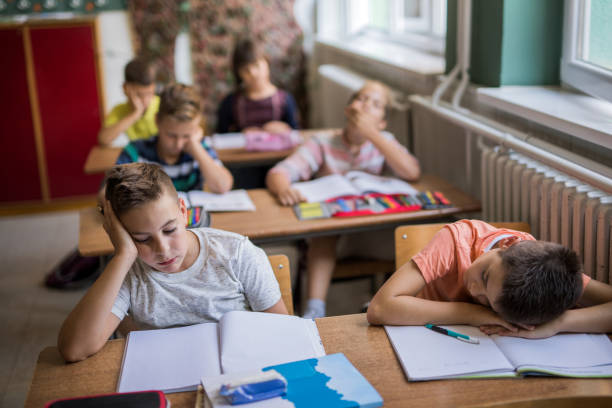








Every morning, we are expected to wake up early just to make it to school on time. This is really difficult, and I often find myself jumping out of bed and rushing to school. Currently, school start times throughout the United States range from 7:00 a.m. to around 8:30 a.m., which happens to be severely harmful to many people. Schools should start at 9:00 a.m. or later, allowing for improvements in students’ biological health, daily mood, mental well-being, and academic focus, as well as for improvements in daily life for parents and teachers.
One of the biggest issues with these early start times is the impact they have on students’ sleep. According to the American Academy of Sleep Medicine, teenagers between the ages of 13 and 18 should get anywhere between 8-10 hours of sleep each night. This isn’t the case though, as studies have shown that in the last decade, students have been getting less and less sleep. According to the surveys from the CDC National Risk Behavior, between 2009 and 2021, the number of students who did not get enough sleep went from 69% to 77%, underscoring the scale of this problem. Students often have homework, family responsibilities, after-school activities, and more, which require them to stay up late. Furthermore, teenagers’ bodies are wired to stay up. When children go through puberty, their circadian rhythms shift, making them more alert in the afternoon and at night rather than in the morning. This keeps students awake, which is why they might need more sleep in the morning.
This lack of sleep affects students’ abilities to perform and function throughout the school day. This includes problems with student attendance, decline in grades, and loss of focus. A study by Wahlstrom and colleagues was conducted in which a school’s start time was delayed from 8:30 to 9:30 a.m. Before the time change, it was reported that 27% of students fell asleep in a morning class and 29% fell asleep in an afternoon class within two weeks. Earlier start times also lead to more absences and tardies due to the morning rush. Maintaining a calm nervous system is important, and so taking it slow in the morning allows individuals to fully wake up without added unnecessary stress. In addition, according to Mountain Heights Academy, research has found that students in schools that start later increase attention and academic performance. This may be because during sleep, the brain processes information learned during the day, clears out toxins, and regulates memories.
Both physical health and mental health are impacted by sleep. For example, growth hormones, which are necessary for adolescent development, including their bone and muscle growth, are released during sleep. Additionally, those who get more sleep are found to build stronger immune systems, making them less prone to illnesses. Many professionals say that there is a correlation between sleep and psychiatric disorders like anxiety or depression. Andrea Goldstein-Piekarski, Stanford Medicine’s assistant professor of psychiatry and behavioral sciences and director of the Computational Psychiatry, Neuroscience, and Sleep Laboratory, says, “It’s becoming increasingly clear that sleep and mood have a bidirectional relationship.” According to the National Sleep Foundation, well-rested teenagers are usually happier and better able to handle the pressures of school and social life. Additionally, relationships and social interactions can improve, which positively affect student well-being.
Students wouldn’t be the only ones who could benefit from a later start time. Teachers and families would benefit as well. In a recent study conducted in Denver, Colorado, where new school start times were implemented, parents of middle and high school students reported feeling more rested and better prepared for the day than when start times were earlier. Teachers agreed that they experienced more energy throughout the day, leading to greater function and improvement in their teaching abilities. This is important because many teachers are stressed with everyday life and need time to recuperate. Michelle Perfect, a professor of school psychology at the University of Arizona, is involved in research that supports this, showing that poor sleep quality is commonly found among teachers. With well-rested teachers and parents, school days become more enjoyable and less stressful for everyone.
In conclusion, if schools truly want to help students succeed and support them emotionally and academically, they need to do what is most beneficial by listening to the majority of people. Pushing back start times to after 9:00 a.m. would significantly improve the lives of students, teachers, and parents. As pediatric sleep psychologist Lisa Meltzer says, “This is a systemic change that can really make a big difference for so many.”