












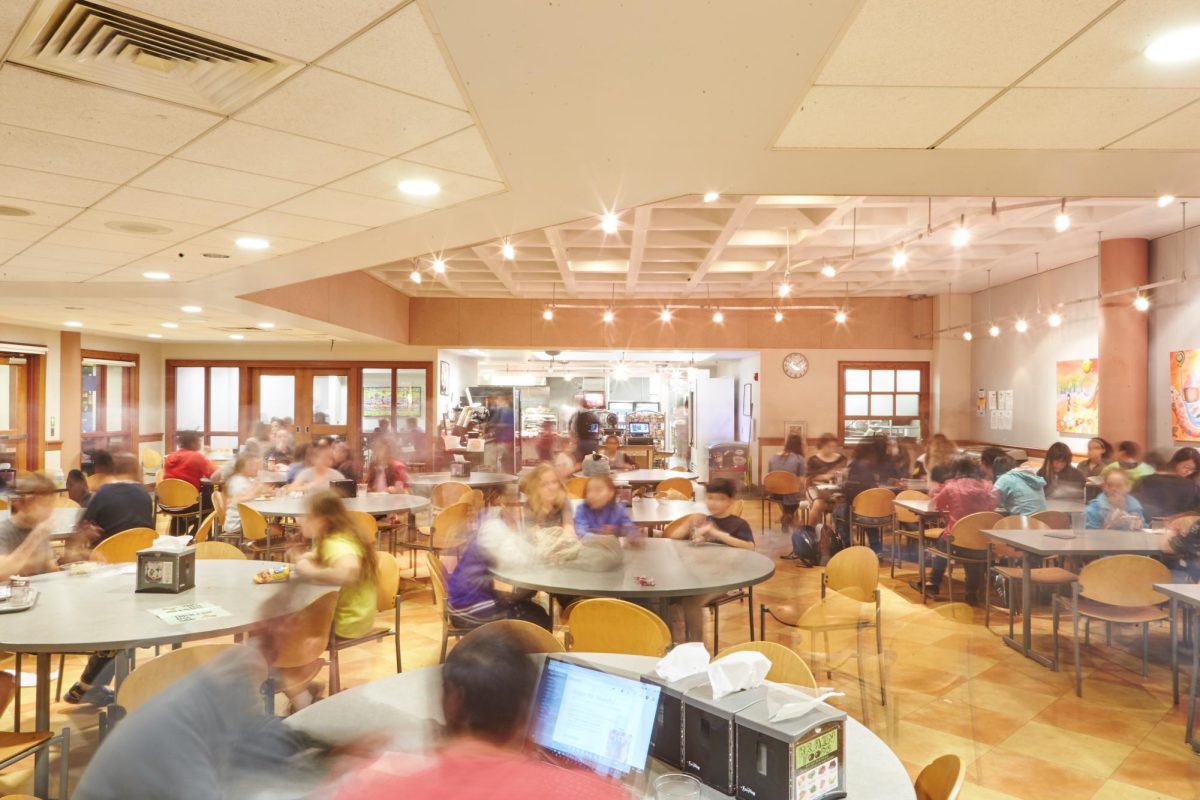
By the time lunch begins at Friends Select School, the line outside the Matthew Huffman ’91 Dining Hall has already begun to form, but inside, some options may run out quickly, prices may feel steep to some people, and students begin to decide whether they want to wait in line or go off campus to find something to eat.
Student dissatisfaction can be based on variety, price, and consistency of the food available. Student data from Friends Select’s Dining Hall Survey in 2024 showed that 35% of students said that there was not enough variety in food options. The survey also indicated that 64% of students agreed that the food in the dining hall is overpriced for what is being offered. Surveys have reported that students have complained about the dining hall food often running out quickly. This can cause problems for students who have to come from class across the street at the STEAM Building, students taking tests or other assessments, and students with disabilities who may arrive at the dining hall later than others. According to Friends Select’s Dining Hall Survey, student respondents have complained about the repetitiveness of the options available: “Many find the recent options repetitive and wish for more variety, or reminisce about previous dining hall selections over the years.”
As a result of these issues, more and more students try to avoid the dining hall and seek alternative lunch options. Students would rather leave campus to seek food out in the Center City rather than rely on the food served in the dining hall. This proves that the majority of the food accommodations in the dining hall aren’t up to the standards of the student population. Others who do choose to eat from the dining hall are presented with overcrowded groups of people and loud noises, driving students away from the dining hall and settling in other classrooms or quiet spaces. The limitations of the dining hall directly contribute to the off-campus lunch culture. It goes without saying that without the implementation of “building leave”, the lunch experience for the upper school students of Friends Select would be much less satisfactory. Surveyed students from Friends Select’s Dining Hall Survey have favored separate spaces, avoiding the dining hall solely because of the noise and crowding. “In the student survey, the most common issue students have with the Dining Hall is how crowded and noisy it is. While the Dining Hall was listed as the most common eating space, it was rivaled by other locations that offered greater respite from noise, especially classrooms.”
These patterns stem from structural changes and policies that have altered how the dining hall operates. Restrictions that were introduced during the COVID pandemic, staggered lunch periods and limited indoor seating. The policies that were introduced may have boosted the momentum of the off-campus lunch culture. Ever since the limitation on student entry into the dining hall, students have become acclimated to eating off-campus, adjusting to the pandemic’s effects. Long-term effects of the pandemic have carried over into modern day, increasing the pattern of students choosing to eat off campus rather than inside the dining hall. According to a 2022 Falcon article, “Limited Dining Hall Access Moves Students Outside for Lunch,” students have been pleasantly surprised with their building leave, with many students excited to explore new lunch options off campus.
Despite these concerns, the school presents the dining hall as a central and positive part of student life, yet it doesn’t always serve as one, which creates a contrast between expectations and the actual experiences of some students. Friends Select acknowledges the importance of community in its shared spaces, “As a school grounded in respect, finding the gifts that each individual brings to the community, and searching for truth, we have curated an educational program that balances support with challenge, seeing yourself in the curriculum and learning about others, and reflecting on our differences and commonalities.” The dining hall is a daily part of student life; it is essential to those who haven’t yet been granted building leave or those who simply don’t have the time to exit the building to search for food off-campus. This directly contrasts with the student reports of dissatisfaction, avoidance, and overall unlikability.
The dining hall at Friends Select reveals a wider issue in how students’ needs are addressed on a daily level, where consistent complaints about cost, quality, and access to more than the preferences of just one student are raised. As students increasingly avoid the space or leave campus as a whole, the dining hall shifts from a shared community to a system that fails to serve the majority of students. This disconnect is intensified by the school’s portrayal of the dining hall as central to student life, revealing a gap between the school’s message and reality. When such a basic necessity like food becomes unreliable, it reflects deeper problems, such as responsiveness and accountability. This means that the system will continue to function without any student-caused changes; the system will continue to function in a way that excludes rather than supports.