
















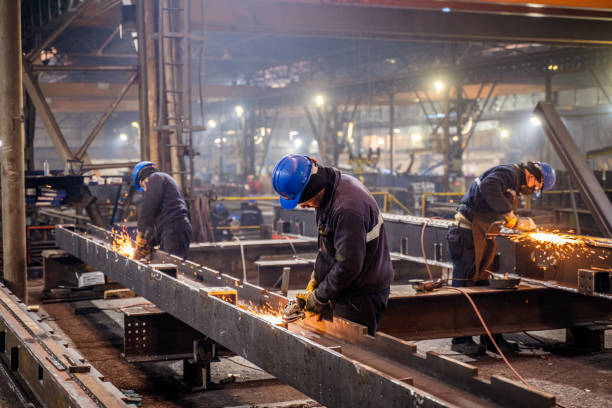
The power in your house goes out, and you flip the circuit breaker, but it still doesn’t work. So you call an electrician, and they fix it with no problems. But what would you’ve done if there weren’t any electricians available? This could be the new reality within the next few years, as the United States is projected to lose countless blue-collar workers. In a Fortune article from 2025, Ford CEO Jim Farley said, “America needed a wake-up call.” As fewer people choose to enter this field, demand for blue-collar workers is growing, as employers try to fill the gaps.
Blue-collar work is defined as employment that requires a lot of manual labor or skilled trade rather than desk-based tasks. Many professions fall under blue-collar work, such as firefighters, electricians, truck drivers, warehouse workers, and many more. According to the Pew Research Center, “Currently, blue-collar workers make up 27% of the U.S workforce.” For generations, blue-collar work has served as a stable occupation for the middle class and has played a vital role in what is seen as traditional American life. However, many of these workers are starting to age out and retire, causing a growing demand for new workers. The U.S. Congressional Budget Office said, “Approximately 30% of certain skilled blue-collar workers … are projected to reach retirement age within the next decade shortages.” As the demand for these workers rises, employers are turning toward Gen Z to fill these positions.
In the past, blue-collar workers were seen as respectable and hardworking members of society. Nowadays, what jobs society values has drastically changed. According to The Annual Blue-Collar Report, “76% of Gen Zs agree there is a stigma associated with going to vocational school over a traditional four-year university.” The public’s standards have shifted for students, and college degrees have become the standard. This shift has led people to view blue-collar workers as uneducated and not contributing to society. Clinton Crawford, an automotive technician in Arkansas, said in an interview with Fortune that “high school-aged children were never presented with blue-collar work as a viable option. Instead, nearly every student was encouraged to prepare for a four-year college education.”
Compared to college, trade schools are rarely advertised as an option for students, leaving them to follow the traditional route. Those who do the non-traditional route are often advised not to and are questioned about it. Students experience this not only in their school environment but from the people around them. When asked about his experience, Friends Select alum Gavin Ewing ‘25 noted he “ran into a few times with small comments and people asking me if I’m sure” about attending vocational school to become an electrician. The stigma around blue-collar work has contributed to this worker shortage, even with such high demand for them. Changing public perception on these jobs is an important step to get the younger generations, including Gen Z, involved.
Gen Z is the next generation expected to fill these positions, and many are starting to shift from 9-5 white-collar jobs towards blue-collar jobs. However, the shortage of workers still remains. Forbes magazine projected “that by 2033, a staggering 1.9 million jobs in the US manufacturing industry alone—nearly 50% of all newly created positions—may be left unfilled due to a massive skills gap.” More students are choosing to go to vocational schools over traditional universities. This can be seen as trade school enrollment has increased over the past few years. According to ADP Research, “Gen Z is becoming the toolbelt generation. Between 2019 and spring 2024, enrollment of bachelor’s degree students fell by 3.6 percent and associate’s degree enrollment fell by 15.9 percent. Vocational enrollment rose by 4.6 percent during the same time period.” Although vocational enrollment is up, it may not be enough to keep up with the growing demand. Factors like the cost of college, job stability as AI is joining the workforce, and simply not wanting a traditional 9-5 have contributed to this growth.
The cost of college is a leading factor in why students are starting to choose trade schools over college. As college has become more popular, it’s become way more expensive. The cost has risen significantly. According to the Education Data Initiative, “The average annual cost of tuition at a public college* is 40 times what it was in 1963; after adjusting for inflation, tuition has increased 312.4%.” Attending a college or university is expensive, and not everyone can afford it. The prices are continually going up and probably won’t stop rising. The Education Data Initiative also notes, “Statistics indicate that the average tuition at all postsecondary institutions will increase 3.25% for the 2026-27 academic year.” Even if students were to go to their state school, the cost is still too high. Comparatively, trade schools cost anywhere from $3,000 to $16,000 a year, and most programs can be completed in 6 months to 2 years. It’s a lot cheaper and more affordable in the long run.
AI is becoming more common in the workplace and could possibly replace some workers in the future. Blue-collar work is mostly physical labor, which AI cannot do at this time. A recent study by the IBM Institute for Business Value found “that organizations deploying AI at an operational level, rather than a skills-based level, outperformed their peers by 44% when it came to metrics such as employee retention and revenue growth.” White-collar jobs are at risk, while blue-collar work appears more secure. Gavin highlighted AI’s lack of ability to do hands-on work, stating, “You need someone with experience to actually know what has to be done. I don’t think that a robot would be able to place beams like an iron worker or wire up a building.”
Some people simply don’t want to have a traditional 9-5 job. Office jobs can be demanding and don’t allow for a flexible lifestyle. Galvin shared, “I think my life would be a lot different if I had chosen to go to college. I don’t think that I would be happy personally. I’ve had the chance to go sit in on my friends’ college classes, and I just couldn’t imagine myself having to do that.”
Blue-collar careers are essential to many aspects of our everyday lives, shaping how our society functions. As this field becomes increasingly appealing to Gen Z, more students are starting to take this route over the traditional university route. While some might argue that students are taking the easy way out, blue-collar work is, in fact, filled with hard labor, requiring problem-solving skills and lots of training. For some people, this might be appealing as a way to contribute to our society positively. As Gavin recommends, “Do what you want to do, not what others want you to do, and not what the traditional blueprint is. Don’t listen to the outside noise with your own life.”