










Maya Vakharia:
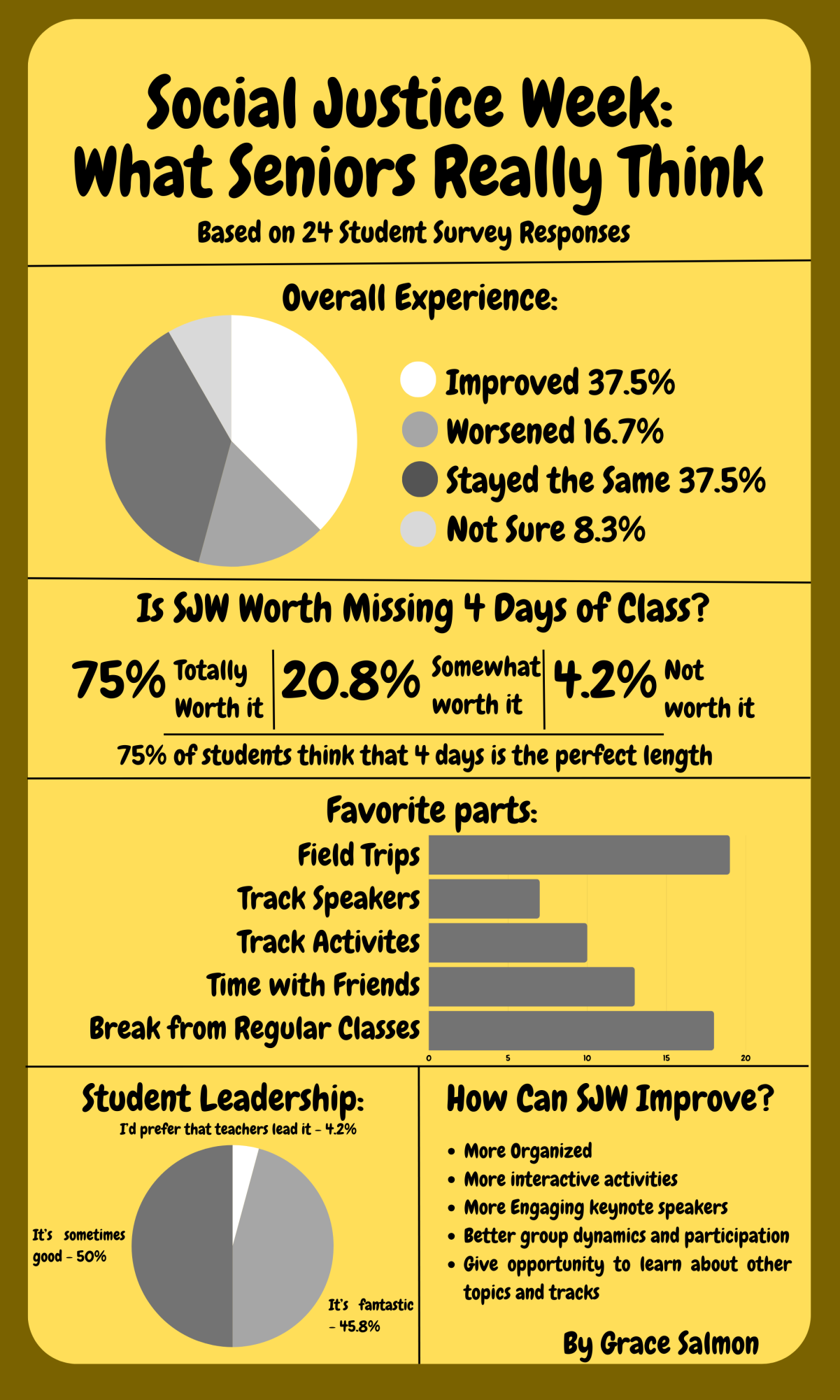
I have personally really enjoyed Social Justice Week throughout my time at Friends Select. I think I was lucky enough to be placed into groups about topics I was genuinely interested in, and that definitely made my experience more positive. I think every group is unique, and may not be for everyone, and that is okay. It’s important for people to learn about issues they may not be as interested in, because that’s how more people become aware of them. I think the most powerful part of the week for me each year has been the keynote speakers. I like that the entire Upper School gets to listen to the speakers, and they are not catered to just one group. I like that we all collectively have a shared time to appreciate the speakers. The speakers are always very informative, entertaining, and inspiring. I think each year has made me feel very informed about the various issues and has made me more inspired to act on them. I really enjoyed the activities and trips we got to take, and I am very appreciative of them.
Bode Wild:
After both participating in and leading groups in Social Justice Week for the last four years, I believe that it should remain a part of the FSS curriculum. The school’s mission statement is that “the purpose of education is preparation for the whole of life.” How can a school prepare its students for the real world without addressing social justice topics that students will encounter every day? Social Justice Week is an opportunity for students to take a step back from the curriculum and explore broader social issues. It also gives all students the opportunity for leadership experience by leading a group and developing a curriculum. While co-leading the sustainable energy group this year, I got to learn in person from professionals in the energy industry and even visit sites that are crucial to energy production in Philadelphia. I learned things that I wouldn’t have in a traditional curriculum. Social Justice Week is a tradition unique to Friends Select School, and it should be continued.
Bryson Evans:
Looking back on Social Justice Week, I think the week was a meaningful experience overall, especially the part where I got put in a group with underclassmen whom I had never seen before. The most powerful part of the week for me was learning about a jazz hall that was actually very close to my house. I also enjoyed some of the group activities that we did because the projects were unique. The keynotes were alright this year; I think I’ve heard better and more interesting ones in years past. Overall, I would say that I learned some interesting things about music that I didn’t know before. I think the only good part of social justice week is that it teaches a lot of kids to interact with each other when talking about heavy topics. I think that if I were in a fun group with my friends, I would enjoy it more than a normal week of school, but when my group isn’t as good, I’d rather be in normal school.
Sam Barth:
I believe that Social Justice Week is a necessary part of every school year. The week provides a moment of respite for the upcoming semester, while enriching students in areas of study that are not taught in conventional schooling. I believe the week allows leaders to take charge and grow their leadership skills through running these groups, something that is radically different from most service projects provided at other schools. The most powerful part of the week is found in the keynote speakers; although sometimes it can feel like they don’t have too much to say, the space they inhabit cultivates speeches that move students. If there were any downsides to this week, it would be found in the activities groups participate in. While some groups are active all day participating in activities that augment students’ knowledge of the subject at hand, other groups can feel unstable and less prepared, which could be remedied with more teacher intervention. Other than this easy fix, however, Social Justice Week is a vital part of the Friends Select experience.
Jonah Gottesman:
In my opinion, Social Justice Week is a good thing to have built into the programming, but not as people might expect it to be. If you think that the student leaders are going to teach you much, think again. As someone who recently led a track group, I didn’t know that much myself. If someone asked me a question, I would not be able to answer it. However, I think the value lies in the speakers who are brought in and how the week makes you see things in a new light. The speakers I had were great. They were able to summarize topics well, dig deeper, and connect dots for me and others in my group. They built off of each other, with one mentioning a program that another was a part of. They gave me an understanding of my topic, what’s going on right now, and what needs to change. Without speakers, SJW would be pointless. Between the speakers and the keynotes, they made me think of things in new ways. For example, an immigration lawyer we had during SJW really cleared things up for me and opened up some new perspectives on the current administration’s goals and map. A problem is the lack of student engagement. Without student engagement, SJW is pointless. As a leader, I saw the lack of attention some students give. When people pay attention, SJW serves as a way to look at an issue in a new light, not to learn how to solve it.
Jake Fogg:
Overall, I think Social Justice Week is a great idea in concept, but in reality, it is typically very hard to execute effectively. Some of the positives that come from the week are learning about meaningful topics, looking good on college applications for leaders, and it’s a nice time to transition to the second semester without being thrown right into the deep end. The problem is that, for one thing, it is an extremely long period of time, and typically it is almost impossible to fill that entire time with meaningful conversation and learning. For another thing, there is no accountability. Leaders aren’t held accountable and nor are their students. Leaders could give zero effort and just do the bare minimum to put it on their college applications. On the other side, students can just show up late to everything or just skip certain periods if they really want to. There are no grades and no requirement to participate in any way, which undermines the whole point of the week being a deeply meaningful experience. I also think that students running the tracks is an extremely difficult task. These student leaders have no teaching experience, so they often struggle to command a room or effectively put together and teach meaningful lessons. Some activities and conversations may work, but on average, it is far more likely that the material fails to be conveyed, especially to students who aren’t even intending to learn. Also, student leaders are not authority figures, which makes their students far less likely to actually listen to them and respect the work they have put in. I think teachers need to play a far larger part in the process than they currently do in order for the week to work correctly. Also, the way students are put into groups is questionable, to say the least. While I understand some students need to be separated, and putting students with different people in theory helps students collaborate and make new connections, in reality, it causes some students to close down as they are alone, which makes it even harder to foster a safe and productive community. Within my own experience, both leading for two years and participating for two years, the speakers are always hit or miss. Sometimes they will be really great and have a lot to offer, while other times they are just talking with no purpose. To be honest, at the end of the day, looking back on it, I feel like the week typically ends up feeling like a joke.
Harshil Bhatia:
The only year I’ve ever had fun in Social Justice Week (SJW) was my 9th-grade year in the prison reform group, led by Nandi Bayard and Lena Kinser. This was the only SJW that I enjoyed because we played Fortnite a bunch during breaks, watched plenty of documentaries, and Matthew bought us pizza. Social Justice Week is only good because we don’t have any actual school. You have to sit there and listen to some of the most boring speakers who genuinely just talk to you for almost an hour, and 75% of the time have nothing interesting to say. Sometimes there will be a fun activity, but then it only takes up a small portion of the day, and you need to go back to sitting and learning about stuff that can be incredibly boring. The biggest issue I have is that groups are randomly selected until this year, which I will get back to. You need to fill out a form and pick your top four choices, and you aren’t guaranteed those top four and sometimes get put with people you have never talked to before, or you get a track that is not interesting at all. Too many people don’t care about Social Justice Week, which, in my opinion, makes it sometimes pointless because if students aren’t going to engage, there is no point putting the effort into teaching them.
Jaiden Spilman:
Over my 4 years participating in Social Justice Week, I’ve learned very little. Every second of it, I think, why am I even here? Most students see it as a break and a time to not do anything productive. After thinking about it more, I’ve realized that it’s simply a marketing scam. The Padlets are just a method of collecting photos and student quotes to post on Instagram for donors to see. They send out photographers, who walk around the school as they fight to take the best diversity pic. The point of all of it is to draw in money, rather than actually working to inspire change within our community.
Bryce Malfitano:
I have never had fun during Social Justice Week. I find it boring, and it does not grab my attention to sit in the same room all day listening to presentations. I have rarely been put into a group with any of my friends, which makes the whole week and experience even less enjoyable. I believe having speakers at 8 in the morning is not a good way to get students to pay attention and actually hear what the speaker is saying. I would rearrange the schedule to allow more movement during the day, and to have speakers at times of the day when people are not just waking up.
Lucarose Pappas:
Social Justice Week is a fun, creative way for students to teach and learn about different community challenges. This week allows students to have a break from our regular curriculum and learn about a specific group. I enjoy the week because it is placed between quarters two and three, which gives me a break from regular school work and lets me learn about a topic that is meaningful to us. I also enjoy the track groups because we are allowed to choose our top four groups, which guarantees that we will be in a group that we like. Social Justice Week also allows students to teach each other what topics that concern them, and because there are students who teach us, they can know better what students want to learn than teachers might. Overall, I would not change Social Justice Week because it is an educational part of our school curriculum that is a different type of learning that other schools do not use.
Maya Dagli:
Friends Select School gives us a week off between the first and second semesters to focus on topics related to social justice. During this week, students explore a range of topics, from ocean conservation and injustice in sports to immigration and consumerism. Students have an opportunity to learn about issues that are prevalent in our world. Most students join groups that interest them, but students also have the opportunity to be leaders of these track groups. This lets them organize and run the week. This provides them with a chance to learn leadership skills, among many others. In these groups, there are a wide variety of activities planned, such as making food, taking trips to local organizations and businesses, and engaging in instructional lessons. Another part of Social Justice Week is keynote speakers, who speak on their passions. I personally really like the idea of social justice week. I think it is a good way to recognize the prevalent issues in our world and learn about the harm they cause. I think that we are able to reflect and also think about our and others’ roles in our society to push towards change. I do think that this could be better executed. I think that while the idea is there, the week could be run more smoothly. I know that it’s a stressful week, but there are many ways that it could be improved upon. Many people don’t get into their groups, which makes many people unhappy for the whole week and thus less productive. Student leaders generally do a great job of planning the week, but I think that more help from teachers could improve the outcome of it. Many days we are actually doing nothing, and while I do appreciate the break that we get, I think that if nothing is going to be learned anyway, then why don’t we have to use that free time elsewhere? Throughout my four years involved in social justice week, I’ve had mixed feelings. Some years, I’ve felt like my week was both fun and educational, while others I feel like it was a waste of my time. I have overall enjoyed the week and really enjoyed the keynote speakers.
Miles Lesser:
Both years, the Discrimination in Sports track group was a lot of fun. The first year we ran it, we had many deep, meaningful conversations that gave students space to share their experiences with discrimination in the sports they play. We also had a great, insightful trip to Citizens Bank Park, where we learned about the connection between the Phillies and the city of Philadelphia. In the second year of the track, we learned a lot from the two speakers who spoke to us. First, Marc Jackson, a former NBA player, came and talked to us about his experience with racism playing basketball. He told us a great story about playing overseas in Turkey during the Greco-Turkish War. He said they played against a team from Greece, in Greece, and the Greek military surrounded the court to protect the players. Another speaker we had was Natalie Randolph, who was the first female football head coach. She shared that the media over-feminized her. In one instance, a documentary crew wanted to put makeup on her playbook for B-roll, but she explained that she doesn’t wear makeup, so they got some from the principal’s assistant and used that instead. Overall, the two years of the Discrimination in Sports track group have been very successful, providing a space for Student-Athletes to speak and learn about different issues around sports.
Theo Stanev Potts:
Personally, I think social justice week is a great opportunity for students to gain new perspectives on important social justice issues, which is the point of the week, but also an opportunity to connect with a new group of people. Looking back, I have always gained valuable knowledge about the world around me. While it is great, I think it could be improved, starting with the keynote speakers. While they do provide a way for students to learn about issues not related to their course, and they can often be very insightful, they are often very boring, and the majority of students retain nothing from them. If the presentations were more interactive or if we had activities instead of lectures, I think more students would pay attention. The other thing that maybe needs to be considered is that students often only choose activities that they are already interested in, and therefore, they don’t expand their knowledge. I think that having students present what they have learned at the end of social justice week to other students would be one way you could educate students in a more diverse range of topics, while still ensuring that students spend the majority of the week studying a topic that they are actually interested in.